
Why Georgia Is a Natural Fit for Digital Nomads and Freelancers
Georgia has become one of those places people rarely plan for long in advance — and yet often stay longer than expected. For digital nomads, freelancers, and location-independent professionals from Europe, Georgia offers something that is increasingly difficult to find: a place where remote work structures make sense, while everyday life still feels rich, human and grounded.
Many people first look at Georgia because it works on paper. What keeps them there is how it feels once they arrive.
A Country That Fits the Reality of Remote Work
Modern work has changed faster than most systems. Freelancers, consultants, developers, designers and online entrepreneurs often work for clients across borders, manage income streams internationally and move between countries depending on season or project. Georgia is one of the few places that seems to understand this reality rather than fight it.
It is possible to build and manage professional structures remotely, without being forced into constant physical presence or rigid commitments. This flexibility allows people to remain mobile while still operating within a clear, legal framework. You can structure your work in a way that supports long-term stability without giving up the freedom that made you location-independent in the first place.
At the same time, Georgia does not punish those who do choose to stay longer. If your setup or tax situation requires spending more time in one place, Georgia does not turn that into a burden. Instead, it becomes an invitation to actually enjoy where you are — not just tolerate it for compliance reasons.
Living Costs That Support Freedom Instead of Pressure
One of the most immediate differences Europeans notice in Georgia is the cost of living — and how much that changes daily life. Rent, food, transportation and services are significantly more affordable than in most Western European cities, without requiring a drastic downgrade in comfort.
This affordability does more than save money. It reduces pressure. Freelancers don’t need to maximize every billable hour just to cover basic expenses. Digital nomads can choose projects more carefully. Long-term planning becomes possible again.
Instead of optimizing life around costs, costs adapt to life.
For many, this is the foundation of real freedom: not having to constantly calculate whether taking time off, slowing down, or changing direction is financially risky. Georgia creates breathing room and breathing room changes how people work, rest and think.
Everyday Life That Feels Rich, Not Empty
Georgia is not just a functional base. It is a place with texture.
Food plays a central role in daily life. Meals are generous, social and unhurried. Traditional dishes like khachapuri and khinkali are more than local specialties; they are part of a culture that values sharing and presence. Wine is not reserved for special occasions, it is woven into everyday moments, often homemade, often shared without ceremony.
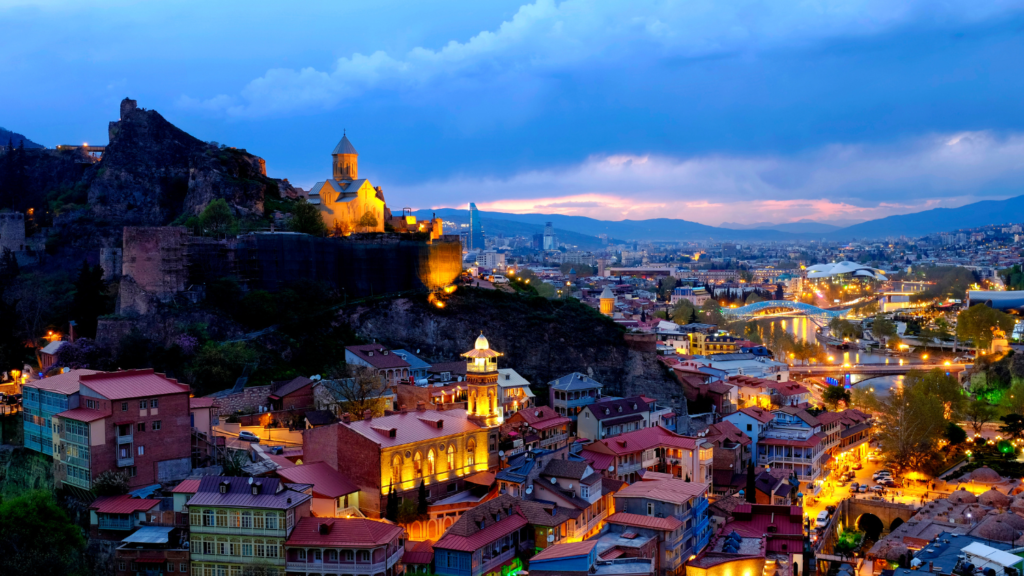
Cities like Tbilisi offer a unique blend of old and new. Historic neighborhoods sit next to modern cafés and coworking spaces. You can work from a laptop during the day and find yourself in a centuries-old street in the evening. The pace is slower but not stagnant. Life feels lived, not staged.
For Europeans who are used to polished but increasingly sterile environments, Georgia often feels refreshingly real. Interactions are direct. Hospitality is genuine. You are treated as a guest, not as a profile or a consumer category.
This matters especially for people who spend a lot of time alone with screens. Georgia offers social warmth without forcing constant interaction, and solitude without isolation.
One of Georgia’s quiet strengths is that it works both as a temporary base and as a place to stay longer. If your personal or tax situation requires spending extended time in one country, Georgia is not a place you endure, it’s a place you can actually enjoy.
Nature is always close. Mountains, forests, wine regions, and the Black Sea are within easy reach. Weekend escapes don’t require complex planning or high costs. Many people find that regular access to nature becomes part of their work-life balance rather than an occasional luxury.
Coworking spaces and remote-friendly cafés provide structure without pressure. There is a growing international community, but it doesn’t feel commercialized. Connections happen naturally, without the constant networking fatigue common in more hyped nomad hubs.
Importantly, Georgia does not demand that you decide everything upfront. You can arrive, observe, settle in and let your plans evolve. Some people stay for a season. Others for years. The country does not force a narrative and that freedom is rare.
Why Georgia Works for Europeans
For Europeans in particular, Georgia offers a combination that feels increasingly valuable: cultural familiarity mixed with real difference. It is close enough to feel accessible, but different enough to reset perspective. The rhythm of life is slower but not disconnected. The system is simpler but not chaotic.
Georgia does not promise perfection. Infrastructure can be uneven. Bureaucracy exists. Adaptation is required. But the overall balance works, especially for people who want to live and work without constant friction.
Georgia is not just a place to build something remotely. It is a place where staying longer can actually enhance quality of life, rather than limit it.
For digital nomads, freelancers, and location-independent Europeans who want both functional freedom and a place that feels alive, Georgia has become one of the most quietly compelling choices in the world right now.


